Somatics as Information, Not Modality:
Recognizing Bodily Cues in Real Time
Live Online Via Zoom
Friday March 12, 2027 12:00 - 3:00 pm Eastern
OR
Saturday March 13, 2027 9:00 - 12:00 pm Eastern
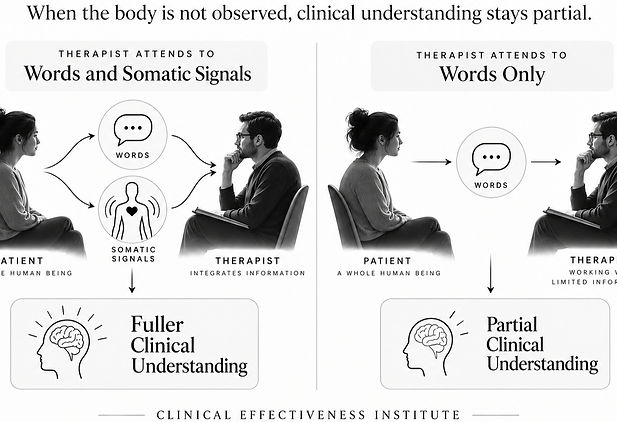
Half the Information in the Room
Every clinician already has access to an entire channel of clinical information: the body. Breathing changes. Posture drops. Gaze goes distant, then returns. This information arrives in every session, with every client, regardless of orientation. Most clinicians see it and let it pass by, because clinical training rarely goes beyond noticing it, leaving half the information in the room unused.
Somatics as Information, Not Modality closes that gap. Working with the body intelligently is a skill any clinician can build inside the orientation they already practice, whether cognitive-behavioral, psychodynamic, trauma-informed, or integrative. The skill set is precision: noticing bodily states clearly, understanding what they may indicate, naming them in language a client can use, and letting the clinical response track with what the state calls for.
What This Training Builds
-
Observation: A wider, more precise read of what is already happening in the room: breathing, gaze, posture, muscle tone, movement, stillness, facial expression, voice, tempo, swallowing, autonomic signs, self-contact, orientation, and reported sensation.
-
Pattern recognition: The component parts of major bodily states, hyperarousal, collapse, constriction, increasing regulation, and loss of relational contact, read as a convergence across channels rather than a single isolated cue.
-
Interpretation: A working read of whether a client is becoming more or less regulated, mobilized, relationally available, and able to reflect, and what that state suggests about what the client can use right now.
-
Clinical language: Direct, concrete phrasing for naming a bodily shift, checking whether an intervention is landing, and inviting a client into their own experience, without sounding intrusive or overly technical.
-
Responsive action: A way of matching pace, demand, orientation, containment, or mobilization to the state observed, and using change from baseline as ongoing feedback on whether the approach is working.
Bringing It Into the Room
A central part of this training is concrete language, sentences a clinician can use in the next session. Examples include naming a shift directly, checking it against the client's own experience, and inviting reflection without interpreting for the client:
-
"Something seemed to shift in your body just then. Did you notice it?"
-
"As you started talking about that, your breathing got much shallower."
-
"Your body seemed to pull back when I said that. What happened for you?"
The training works through when to name a shift directly, when to ask what the client notices, when to make a tentative connection, and when to stay quiet and keep observing.
Who This Is For
Clinicians, counselors, therapists, social workers across settings and orientations who already notice bodily shifts in session and want a working method for interpreting them, discussing them with clients, and using them to guide the clinical work. Clinicians bring whatever background they already have, and apply the method directly inside their current practice. A clinician does not need to become a somatic therapist to work intelligently with the body.
Training Details
Live online via Zoom, 3 hours
Choose either:
Friday, March 12, 2027, 12:00 PM – 3:00 PM Eastern
Saturday, March 13, 2027, 9:00 AM – 12:00 PM Eastern
TUITION Standard: $50 · CMH: $35 · Scholarship available by request