Clinical Formulation:
The Missing Link Between Understanding and Intervention
A Three-Hour Live Online Intensive in Clinical Reasoning
Friday, October 23, 2026 12:00–3:00 PM Eastern Live Online
Tuition: $70 (No continuing education credits are offered for this program)
Course Description
Psychotherapists routinely gather extensive information about their clients: histories, symptoms, diagnoses, relational patterns, developmental experiences, and recurring difficulties. Understanding a client's subjective experience in depth does not answer the central clinical question: what appears to be maintaining the difficulty, and what does that understanding imply for the clinical work?
That is the task of clinical formulation, the process of developing an individualized, provisional, and revisable explanation of a client's difficulty. Formulation connects observation to clinical reasoning and clinical reasoning to intervention, giving the clinician a basis for deciding what to attend to, what kind of change the work is attempting to produce, and when persistent nonresponse should prompt reconsideration.
This intensive makes that process explicit. Participants will learn to move from a client's narrative and presenting concerns to recurring pattern recognition, working formulation, clinical targets, and a plan for testing and revising the formulation as the work proceeds, with an emphasis throughout on disciplined clinical reasoning rather than allegiance to any particular psychotherapy modality.
The Problem This Intensive Addresses
A clinician may be thoughtful, experienced, and know a client well, understanding their triggers, history, diagnoses, and relational patterns, and still lack a working explanation of the problem. Without an explicit formulation, clinical work can become a sequence of reasonable responses to whatever appears in the room: anxiety leads to grounding, avoidance leads to exposure, trauma history leads to trauma processing. Each response may be legitimate on its own terms. Formulation asks a different question: why this intervention, for this person, at this point in the work?
Course Premise
Diagnosis classifies. Assessment gathers information. Treatment planning identifies goals and intended interventions. Formulation attempts to explain.
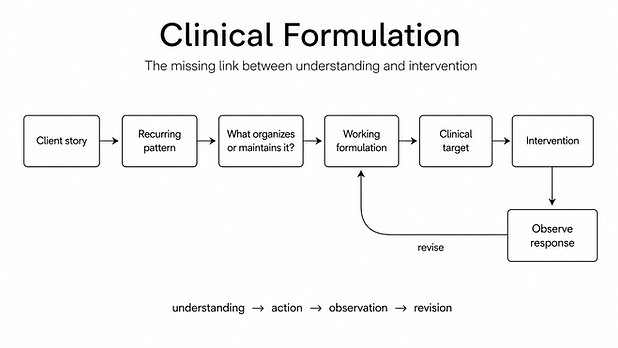
A working formulation asks what is happening, under what conditions, and what appears to organize or maintain it, along with what observations support that understanding, what it implies for the clinical work, and what would prompt reconsideration if the clinician turns out to be wrong. The aim is disciplined, revisable clinical thought, following the sequence:
client story → recurring pattern → organizing or maintaining process → working formulation → clinical target → intervention → observed response → revision
Learning Objectives
By the end of the intensive, participants will be able to:
-
Distinguish clinical formulation from assessment, diagnosis, case description, and treatment planning
-
Identify recurring psychological patterns within a client's narrative without prematurely assigning them to a diagnostic or theoretical category
-
Move from descriptive clinical information toward a provisional explanatory account
-
Identify conditions that reliably precede, intensify, reduce, or maintain a client's difficulty, and distinguish the pattern from the mechanism maintaining it
-
Generate multiple plausible hypotheses without treating any one as established prematurely
-
Identify a clinical target that follows from the formulation without substituting the clinician's preferred life outcome for the client's own authority
-
Use the formulation to organize clinical inquiry and intervention
-
Recognize when persistent nonresponse should prompt reconsideration, and revise a formulation when clinical information does not support it
Curriculum
I. What formulation is, and what it is not. Distinguishing formulation from diagnostic assessment, biopsychosocial information gathering, treatment planning, theoretical orientation, and intervention selection.
II. From client story to recurring pattern. Careful pattern recognition, before interpretation: what happens repeatedly, under what conditions, and what changes in the client once it begins.
III. Psychological organization before etiology. A clinician can often identify how a difficulty is currently organized before knowing its developmental origin. Etiology may become clinically important; it does not have to be known before useful formulation begins.
IV. Moving from pattern to working explanation. Examining possible maintaining processes, including avoidance, reinforcement, learned expectations, relational contingencies, and cognitive interpretation, while remaining explicitly trans-theoretical. The task is not to identify the clinician's preferred mechanism but to determine which explanation best fits the available evidence.
V. Generating and testing clinical hypotheses. Developing several plausible explanations and discriminating among them through further inquiry and observation, including what supports a hypothesis, what weakens it, and what remains unknown.
VI. Identifying the clinical target. A clinical target should follow from the formulation rather than restate the presenting problem, distinguishing the client's life decision from the psychological capacity the clinical work is intended to strengthen.
VII. From formulation to intervention. How an explicit formulation guides which questions are asked, which interventions are selected, and when the clinician should continue, modify, or abandon an approach.
VIII. Nonresponse as clinical information. Persistent non-change is one of the most important tests of a formulation. Explanations such as needing more time or trust may be correct, but they should not absorb every possible outcome indefinitely.
IX. Revising the formulation. A working formulation should become more accurate over time. Revision is not evidence that formulation failed; revision is part of formulation.
Case-Based Application
The intensive includes detailed examination of a clinical case illustrating the movement from narrative material to pattern recognition, working formulation, maintaining process, clinical target, and criteria for revision, used to demonstrate clinical reasoning rather than to teach a predetermined modality.
A Working Formulation Should Be Able to Answer
By the end of the training, participants should be able to bring a client to mind and begin answering five questions: what do I think is happening, what do I think is organizing or maintaining it, what observations support that understanding, what does that understanding imply for the work, and what would I expect to observe if I am right, or that would make me reconsider? A formulation does not have to be complete. It has to be specific enough to guide clinical reasoning.
What this Intensive Does Not Cover
This is not a modality certification, a protocol training, or a course in one theoretical school of psychotherapy. It is not a diagnostic workshop or a seminar in writing treatment plans, and it does not argue that every client has one discoverable psychological explanation. The focus is a more foundational competency: developing an individualized working understanding of the client that is explicit enough to guide the work and provisional enough to change when the evidence does not support it.
Intended Audience
This program is designed for practicing and developing psychotherapists, including clinical social workers, professional counselors, psychologists, marriage and family therapists, graduate and postgraduate clinicians, and supervisors, as well as experienced clinicians who want to make their clinical reasoning more explicit. Participants from different theoretical orientations are welcome, and no prior training in a particular psychotherapy model is required.
Level: Intermediate / Advanced. The training assumes familiarity with basic psychotherapy practice and is designed for clinicians who want to deepen their ability to reason about individual cases rather than acquire another intervention protocol.
Early-career clinicians are also welcome, particularly those seeking a more explicit framework for connecting assessment to intervention.
Instructional Format
This three-hour live online intensive combines didactic instruction, structured clinical examples, case formulation demonstration, comparison of competing hypotheses, application exercises, and live questions and clinical discussion, with an emphasis throughout on applied clinical reasoning.
About the Clinical Effectiveness Institute
The Clinical Effectiveness Institute develops clinical education focused on the professional capacities that determine whether psychotherapy becomes useful: careful observation, psychological understanding, formulation, clinical judgment, regulation, intervention, and ongoing evaluation of the work. The Institute's central concern is not allegiance to a particular modality. It is the quality of the clinician's thinking.
Many clinicians were taught how to diagnose, how to write treatment plans, and how to recognize multiple psychotherapy theories. Far fewer were given a sustained, practical method for answering the question that sits between all of those activities: what do I actually think is happening with this person? Clinical formulation is that missing link.
Clinical Formulation: The Missing Link Between Understanding and Intervention
Friday, October 23, 2026 12:00–3:00 PM Eastern Live Online $70 inaugural tuition
No continuing education credits are offered for this program. You do not need a complete theory of a client before you begin working. You do need a way to keep asking whether your understanding is becoming more accurate. Clinical formulation gives the work a structure for doing that. Understanding → Action → Observation → Revision.
This training is intentionally priced below many comparable professional trainings. CEI is committed to making rigorous clinical education accessible while building an ongoing community of clinicians invested in developing their clinical judgment. A small number of reduced-fee and full scholarships are available for clinicians for whom the registration fee would otherwise prevent attendance. To request a partial or full scholarship, please email sarahozolshore@gmail.com